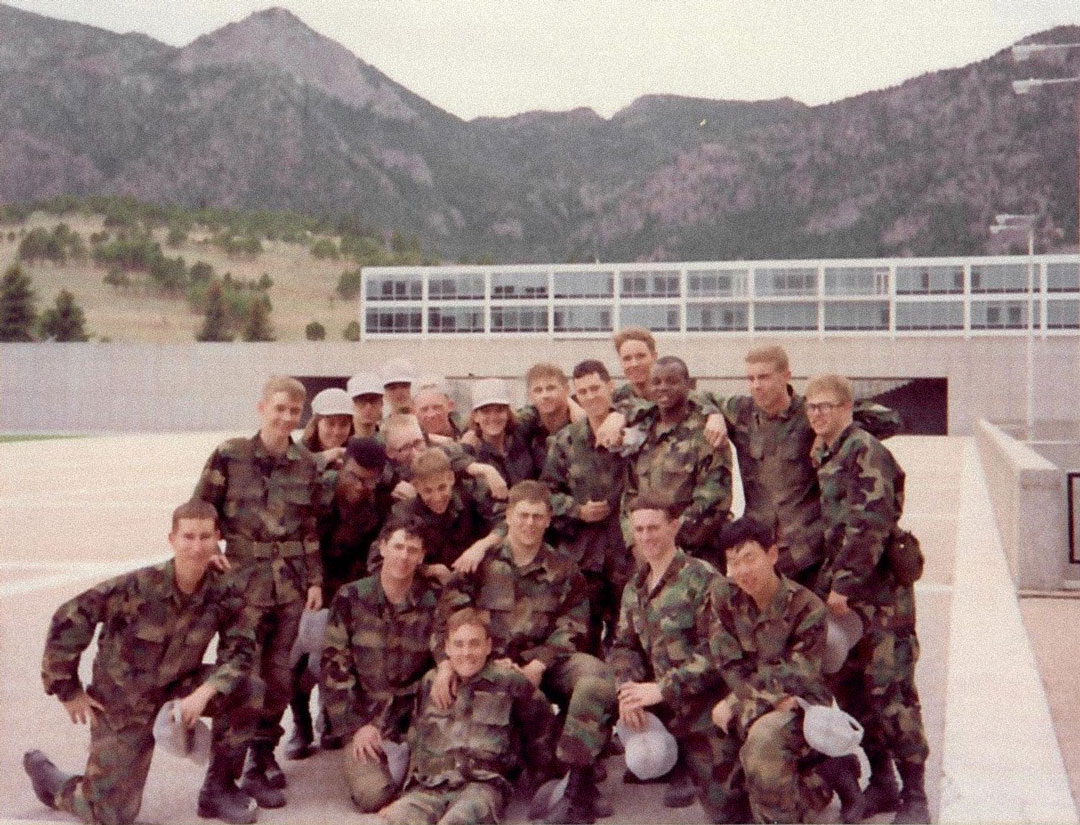
I knew it was coming, but that didn’t make it suck any less. My brothers had walked this path before me, and now it was my turn.
Minutes after stepping across the yellow line to begin the six-week boot camp at the U.S. Air Force Academy, I assumed my position in school lore. Boot camp there is called Basic Cadet Training, and every new trainee is known as “Basic Cadet ____.” So you’d hear names like “Basic Smith” or “Basic Jones.”
And then… there was me. “Basic Basik.”
(Pronounced exactly the way you don’t want it to be.)
At a time when you’re trying to avoid all attention, my name became a running joke. The cadre loved it.
But as uncomfortable as that label was, it wasn’t the hardest part of being a freshman—or “Doolie.” The real challenge was something every one of us had to wrestle with. It was frustrating then, but the lesson it taught has shaped me for more than three decades since crossing that yellow line.
The Seven Responses
Freshmen at all the Service Academies—the Air Force Academy, and even those lesser schools at Annapolis and West Point—are limited to just seven approved responses when speaking to upperclassmen:
- Yes, sir (or ma’am).
- No, sir.
- Sir, I do not know.
- Sir, I do not understand.
- Sir, may I make a statement?
- Sir, may I ask a question?
- No excuse, sir.
By far, the hardest—and most valuable—was #7.
Because it was the only acceptable answer to a “Why” question.
- “Basic Basik, why are you late?”
No excuse, sir. (Even if another upperclassman held me up.) - “Basic Basik, why is your shirt not ironed?”
No excuse, sir. (Even if my iron broke, and I couldn’t replace it.) - “Basic Basik, why is your classmate not here?”
No excuse, sir. (Even if I had no idea who he was talking about.)
Even when there was an excuse, you couldn’t use it. Because no one cared.
The Gift of Accountability
At first, that felt harsh and unfair. But over time, I realized it was a gift—a forced repetition that built muscle memory.
It trained us to take ownership. To stop wasting energy defending ourselves and start directing it toward improvement.
Years later, after returning to the Academy to teach leadership, one of my former students—now (then) a commander, Matthew Bartomeo—gave me a powerful distinction:
“A reason is why something happened.
An excuse is why it’s not my fault.”
Too many people (and too many leaders) default to that second one—and it’s weak.
Benjamin Franklin said it well: “He that is good for making excuses is seldom good for anything else.”
Why It Still Matters
Of course, there are reasons for things. But choosing “No excuse” first strengthens a leader’s reflex toward accountability.
In a world that often rushes toward blame, deflection, and “it’s not my fault,” a simple “No excuse, sir” is shockingly refreshing—and deeply inspiring.
Leaders of character own it.
They take responsibility for their attitudes, their actions, their decisions, and their outcomes—especially when it’s uncomfortable or inconvenient.
Take it from “Basic Basik”:
Owning the 7th response might just be the most powerful leadership lesson you ever learn.